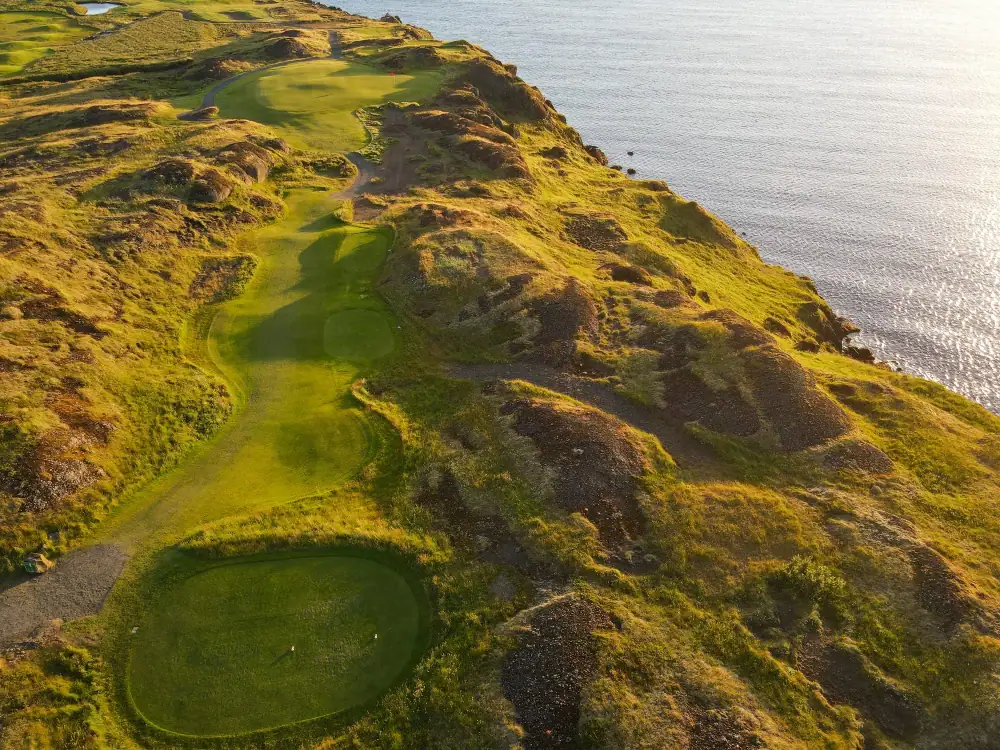
Laid on the land, not carved into it.
Edwin Roald: the routing
Icelandic golf architect Edwin Roald is best known around the world for asking an awkward question: why 18 holes? His argument is that a course should have as many holes as the land offers, not a number fixed in St Andrews in 1764. At Brautarholt he traced a route around the edge of the Músarnes headland to meet the sea as often as the ground allowed. For years the course had just twelve holes, and it was ranked among Europe's best regardless.
"When you have limited resources, you are forced to use what nature has given you."
Michael Kelly: the original holes
American designer and shaper Michael Kelly, with more than 35 years and over 100 courses behind him, built the original holes on site. He laid them onto the existing rock, water and slopes instead of flattening the ground.
"He's a proponent of laying the golf course on the land and using the natural hazards."
Tony Ristola: the new north
From April 2022, Canadian-born architect Tony Ristola, who is based in the Czech Republic, shaped the final holes himself, heading north along a ridge of ancient basalt. The newest holes show more of the rock. In July 2025 they took Brautarholt to a full eighteen.
What the experts say
"A brilliant routing by Edwin Roald produced a succession of fine holes."
"I am not sure I have ever seen a course more closely connected to the sea."